

HER3 in cancer







HER3 Biology
HER3/ERBB3 is one of the four members of the HER family of receptor tyrosine kinases1,2
-
Show more Show less
- All four members of the HER family share a common molecular structure and play a role in normal cell biology1–4
- Members of the HER family are expressed widely in numerous cell types, including epithelial, neuronal, and mesenchymal cells1
- HER3 activation depends on heterodimerization with another receptor to induce downstream signaling pathways4
- Although HER2 is generally its preferred dimerization partner, HER3 can dimerize with other receptors in the HER family2,4
- HER3 also dimerizes with some non-HER family receptors, including MET and FGFR24,5
HER3 dimerization and activation are involved in normal cell physiology1
-
Show more Show less
- In normal physiology, binding of the ligand (heregulin, a neuregulin family member) leads to dimerization1
- After dimerization, HER3 relies on its dimer partner’s tyrosine kinase activity, which can then phosphorylate one or more of the tyrosine residues on its intracellular kinase domain4, 5
- This leads to activation of pathways that regulate normal cell division, proliferation, and differentiation4,5
Abbreviations: EGFR, epidermal growth factor receptor; ERBB3, receptor tyrosine-protein kinase erbB-3; FGFR2, fibroblast growth factor receptor 2; HER, human epidermal growth factor receptor; MET, mesenchymal-epithelial transition factor.
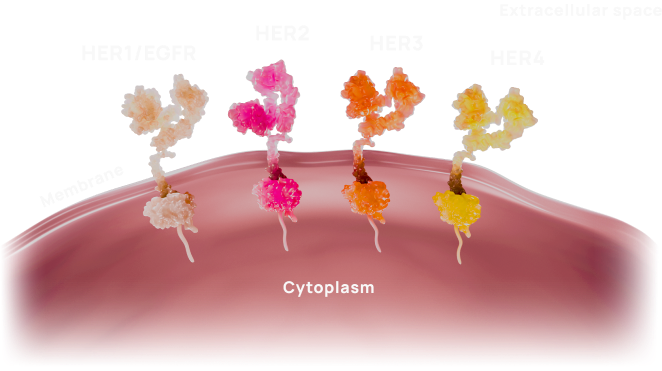 Adapted from Black LE, et al. Am J Pathol. 2019;189:1898–1912.
HER3 Expression in Solid Tumors
HER3 is expressed in many solid tumors6–21
HER3 expression has been reported in the following solid tumors:








HER3 expression is associated with poor prognosis in many solid tumors9–21
Across malignant solid tumor types, including breast cancer, cervical cancer, colorectal cancer, gastric cancer, HNSCC, melanoma, NSCLC, ovarian cancer, and pancreatic cancer, HER3 expression is associated with poor prognosis
HER3 expression is higher on tumor cells compared with normal healthy cells22
Abbreviations: HER3, human epidermal growth factor receptor 3; HNSCC, head and neck squamous cell carcinoma; NSCLC, non-small cell lung cancer.
HER3 in Cancer Cells
-
Show more Show less
- HER3 activation can sustain several oncogenic signaling pathways, including PI3K/Akt, MAPK, JAK/STAT, and SRC1,2,23,25
- Amplification/mutation/overexpression of HER3 ligands and dimerization partners, including HER and non-HER RTKs, such as MET, can promote bypass signaling through activation of these signaling pathways2,25−29
- MET amplification may lead to increased cellular proliferation by maintaining HER3-mediated activation of downstream PI3K/Akt signaling25,26
- Overexpression of HER3 ligands heregulin/neuregulin has been shown to be a driver of breast cancer progression in preclinical models30
- Inhibition of HER3 dimerization partners or their downstream pathways can lead to compensatory upregulation of HER32
- Increased HER3 signaling or expression may play a role in the initiation of signaling activity leading to increased cellular proliferation, invasion, and migration in multiple tumor types, including breast, HNSCC, colorectal, and lung cancers1,2,4,31,32
Abbreviations: Akt, protein kinase B; HER, human epidermal growth factor receptor; HNSCC, head and neck squamous cell carcinoma; HRG, heregulin; JAK, Janus kinase; MAPK, mitogen-activated protein kinases; MET, mesenchymal-epithelial transition receptor; MEK, mitogen-activated protein kinase kinase; P, phosphoryl; PDK1, phosphoinositide-dependent kinase-1; PKC, protein kinase C; PLC-γ, phospholipase C, gamma; PI3K, phosphoinositide 3-kinase; RAF, rapidly accelerating fibrosarcoma protein; RAS, rat sarcoma virus protein; RTK, receptor tyrosine kinases; SRC, proto-oncogene tyrosine-protein kinase Src; STAT, signal transducer and activator of transcription; TK(I), tyrosine kinase (inhibitor).
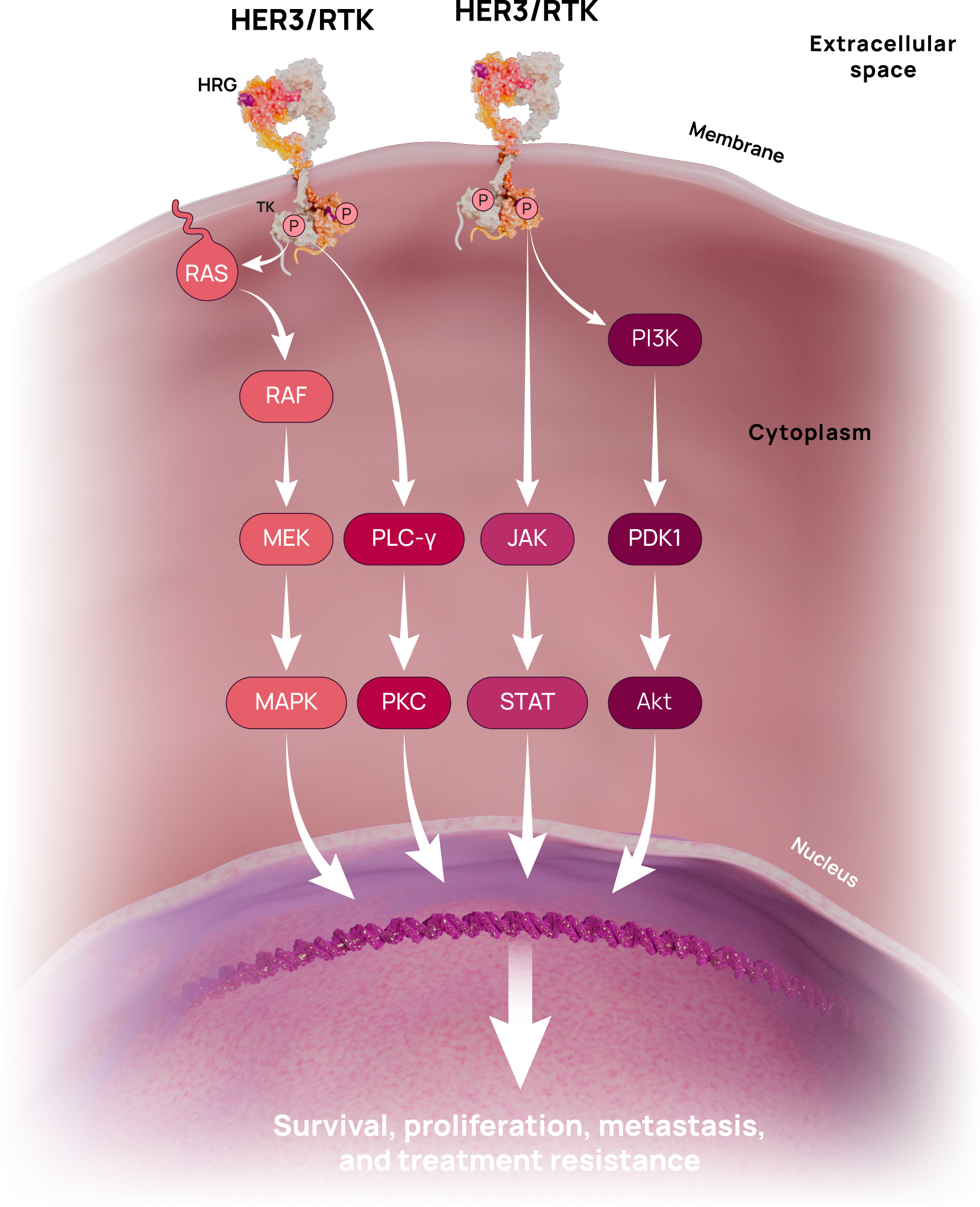 Adapted from Mota JM, et al. Oncotarget. 2017;8:89284–89306.
Reference List
1. Mishra R, et al. Oncol Rev. 2018;12:355. 2. Lyu H, et al. Acta Pharm Sin B. 2018;8:503–510. 3. Black LE, et al. Am J Pathol. 2019;189:1898–1912. 4. Haikala HM, Jänne PA. Clin Cancer Res. 2021;27:3528–3539. 5. Uliano J, et al. ESMO Open. 2023;8:100790. 6. Soo RA, et al. Future Oncol. 2024;20:2961−2970. 7. Scharpenseel H, et al. Sci Rep. 2019;9:7406. 8. Li Q, et al. Oncotarget. 2017;8(40):67140–67151. 9. Travis A, et al. Br J Cancer. 1996;74:229–233. 10. Tanner B, et al. J Clin Oncol. 2006;24(26):4317–4323. 11. Fuchs I, et al. Anticancer Res. 2007;27:959–963. 12. Chang CS, et al. Cancers. 2022;14:2139. 13. Lédel F, et al. Eur J Cancer. 2014;50:656–662. 14. Scartozzi M, et al. Ann Oncol. 2012;23:1706–1712. 15. Capone E, et al. Cell Death Discov. 2023;9:400. 16. Hayashi M, et al. Clin Cancer Res. 2008;14:7843–7849. 17. Takikita M, et al. J Transl Med. 2011;9:126. 18. Reschke M, et al. Clin Cancer Res. 2008;14:5188–5197. 19. Shteinman ER, et al. Pathology. 2023;55:629–636. 20. Hirakawa T, et al. Oncology. 2011;81:192–198. 21. Li Q, et al. BMC Cancer. 2016;16:910. 22. Inaki K, et al. PLoS One. 2022;19:e0274140. 23. Gala K, Chandarlapaty S. Clin Cancer Res. 2014;20:1410–1416. 24. Mota JM, et al. Oncotarget. 2017;8:89284–89306. 25. Romaniello D, et al. Cancers (Basel). 2020;12:2394. 26. Engelman JA, et al. Science. 2007;316:1039–1043. 27. Yonesaka K, et al. Clin Cancer Res. 2022;28:390–403. 28. Lipton A, et al. Breast Cancer Res Treat. 2013;141:43–53. 29. Sergina NV, et al. Nature. 2007;445:437–441. 30. Majumder A. Cells. 2023;12:2517. 31. Haikala HM, et al. Cancer Res. 2022;82:130–141. 32. Yonesaka K, et al. Oncogene. 2019;38:1398–1409.